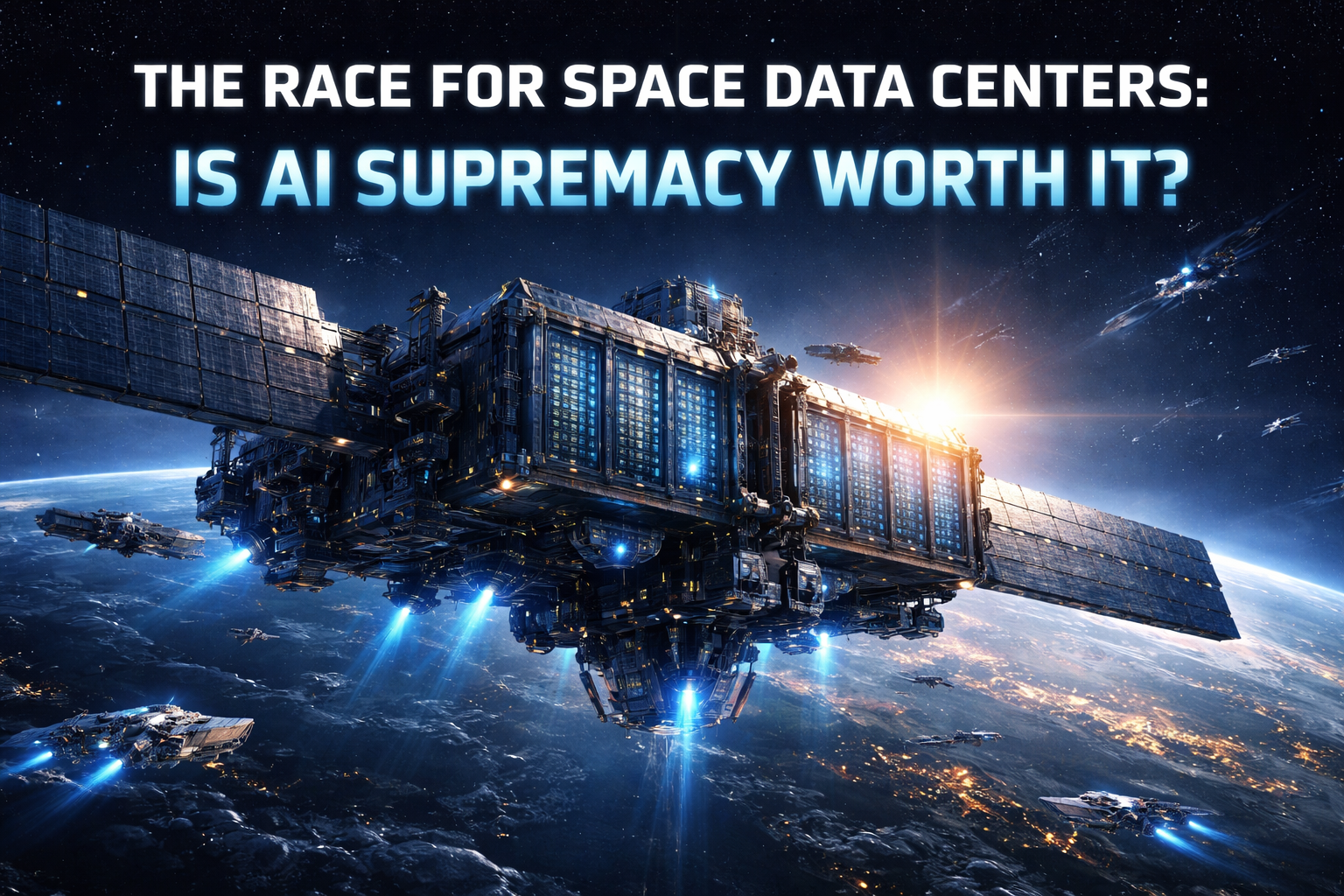
Tech billionaires are looking beyond Earth’s atmosphere, not for exploration, but for compute power. Elon Musk, Jeff Bezos, Google, and a handful of daring startups are betting that orbital data centers could redefine AI, sustainability, and strategic control. But is it really worth it?
WHY SPACE FOR DATA CENTERS?
The logic is seductive:
- Unlimited solar energy: In orbit, servers bask in near-constant sunlight. No grid needed.
- Vacuum cooling: Heat radiates directly into space, eliminating the massive water usage and cooling costs plaguing terrestrial data centers.
- Low-latency satellite AI: Data generated in space, like Earth observation or defense intelligence, can be processed immediately without waiting for transmission back to Earth.
In theory, it’s an elegant solution to energy and cooling bottlenecks, the kind that could power next-generation AI models.
THE REALITY CHECK
Here’s why orbital compute isn’t a silver bullet:
- Launch emissions: Every kilogram sent to orbit creates massive carbon and black-carbon footprints. Today, launch pollution alone outweighs energy savings.
- Radiation damage: Space degrades chips faster. Servers must be radiation-hardened or replaced frequently, driving costs and emissions up.
- High capital cost: Launching, repairing, and operating orbiting servers is exponentially more expensive than Earth-based hyper-scale data centers.
- Limited general applications: Most AI workloads: cloud apps, general research, or enterprise AI, are still better served on Earth.
Bottom line: today, space data centers are more a vision than a practical solution.
STARTUPS & THE RACE TO ORBIT
A few daring players are exploring this frontier:
- Starcloud - Launching GPUs into orbit for early AI compute.
- Sophia Space - Modular edge compute satellites for low-latency workloads.
- Axiom Space - Integrating orbital compute nodes into commercial space stations.
- Lonestar Data Holdings - Lunar data storage (less compute, more resilience).
Big tech and state-backed initiatives also experiment with orbital AI, but full-scale operational data centers remain years away. Most of these efforts are more about proving the concept than scaling AI today.
SUSTAINABILITY: HYPE OR REALITY?
Orbital data centers are pitched as green: solar-powered, vacuum-cooled, minimal land use. But in practice:
- Launch emissions and hardware manufacturing currently negate most sustainability gains.
- Hardware lifetime is short due to radiation, requiring replacement missions.
- Only niche workloads (satellite AI, astronomy, or defense) justify the enormous resource cost.
Until green, reusable launch tech and long-lived space hardware exist, sustainability is more marketing than reality.
AI SUPREMACY: THE REAL DRIVER
Why risk billions to orbit servers? Not because of ROI or environmentalism - it’s power.
- Compute dominance: Faster AI training, bigger models, strategic edge.
- Control and leverage: Space AI could act like a deterrent or chokepoint - whoever owns it wields influence.
- Perception: Being first in orbit signals technological inevitability and scares competitors.
For general AI applications or Earth-focused services, orbiting data centers are overkill. But for billionaires seeking control, influence, and strategic leverage, the gamble is worth it.
WHO COULD WIN?
- Musk/SpaceX - Starlink satellites as modular AI platforms.
- Bezos/Blue Origin - Long-term infrastructure and lunar expansion.
- Google - Research prototypes for orbiting AI compute.
- China - Satellite constellations with onboard AI processing.
The winner isn’t just about technology - it’s about who can maintain orbiting compute, launch efficiently, and monopolize strategic AI chokepoints.
OUTRO
Space data centers are fascinating, audacious, and mostly speculative. For sustainability, they’re premature. For AI supremacy, they’re a calculated power play.
The real question for startups, investors, and strategists isn’t “can we build it?” - it’s “do we want to chase power in orbit, or practical AI on Earth?”
Until launch tech and orbital hardware mature, the answer remains murky. But one thing is clear: the race has begun, and the stakes are astronomical.

Which stocks are leveraged to space data centers, and how long is the bet?

Three public stocks aligned with space data centers:
Redwire ($RDW) builds space infrastructure hardware (power, deployables, robotics) that orbital data centers would physically depend on. Rocket Lab ($RKLB) is the deployment choke point (launch + satellite platforms) as more orbital compute means more launches and custom spacecraft. Planet Labs ($PL) is the demand-side proxy, generating massive orbital data that increasingly needs on-orbit AI processing.
Time horizon: this is a long-term theme. Expect 1-3 years of prototypes and experiments, 3-7 years of early commercial use, and 7-15+ years before space data centers materially matter. This isn’t a trade, it’s infrastructure positioning.

But doesn't this align with Elon's long term space plans especially for Mars? I mean building out these data centers can be a good training for future Mars explorations right?
Yes, you’re right. Orbital data centers align directly with Musk’s Mars plan, not because they’re optimal for AI today, but because they’re practice for off-world civilization.
In one tight frame:
>> Mars requires autonomous power, cooling, compute, and AI with no Earth dependency.
>> Orbital data centers force SpaceX to solve those exact problems now, in a lower-risk environment.
>> AI isn’t the end goal, self-sustaining systems are.
>> Sustainability in space isn’t ideology; it’s survival physics.
Bottom line: Space data centers aren’t about near-term AI ROI, they’re rehearsals for Mars.

dame bro that's lit
dame bro were entering space age man damn bruv
are they goona mine minerals like in starcraft bro?? damn
i heard China found a rock somewhere in space with lots of rare earth minerals
bro i wanna work in a space data center bro its dope
just goona float all day there
dame bro


@alexo @cryptohustlr @strataghost @alexjones @grungechain Thanks for all your comments! Just sent you 50 $GMBLR tokens each. Keep stacking GMBLR tokens, you'll be using it soon for amazing perks.