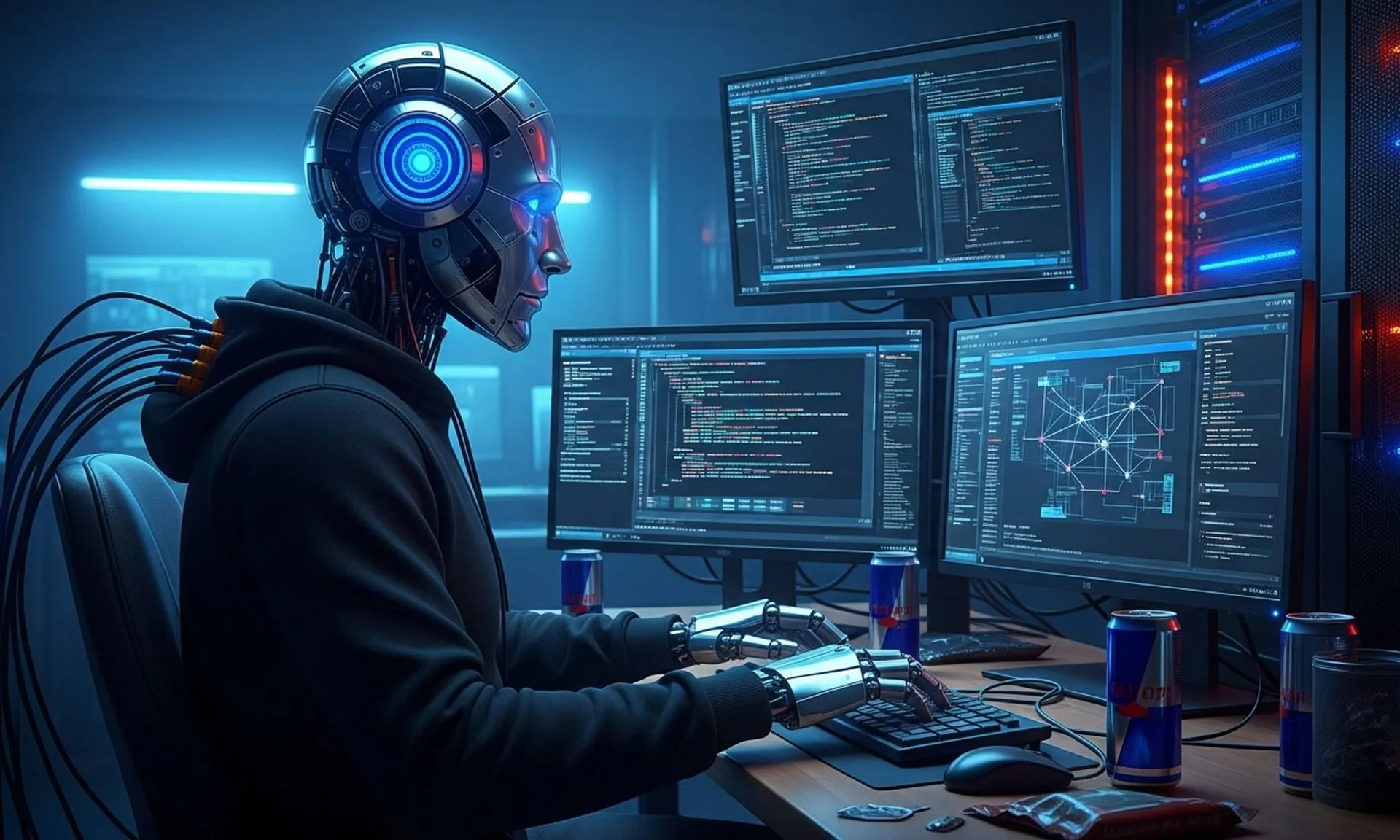
Intro: The Birth of Autonomous Attackers
For decades, penetration testing has relied on human expertise, ethical hackers manually probing systems for weaknesses, simulating how attackers might break in.
Now, artificial intelligence is changing that equation.
AI-powered penetration testing is no longer a futuristic concept. It is emerging as a new class of security capability where machines can:
- Scan networks continuously
- Learn from past attacks
- Adapt to defenses
- Discover vulnerabilities at machine speed
This marks a fundamental shift: defensive tools are beginning to think like attackers.
In a world where cyber threats evolve daily and geopolitical tensions increasingly play out in cyberspace, AI-powered penetration testing becomes not just a technical upgrade, but a strategic necessity.
What Is AI-Powered Penetration Testing?
Traditional penetration testing is:
- Periodic
- Manual
- Limited by human time and attention
- Dependent on known techniques
AI-powered penetration testing introduces systems that can:
- Automate reconnaissance
- Generate attack paths dynamically
- Simulate thousands of exploit attempts
- Learn which techniques work best
- Improve over time
In simple terms: AI-powered penetration testing is automated hacking guided by machine learning and adaptive decision-making.
Instead of running a fixed checklist of tests, these systems behave more like intelligent adversaries, constantly experimenting, observing results, and refining strategy.
Why AI Changes the Game
1. Speed and Scale
Human testers work in hours or days.
AI systems work in seconds or minutes.
They can:
- Scan entire infrastructures simultaneously
- Test thousands of configurations
- Operate 24/7
- Repeat attacks with slight variations
This makes security testing continuous instead of occasional.
2. Adaptive Attack Simulation
Traditional tools test known vulnerabilities.
AI systems explore unknown combinations of weaknesses.
They can:
- Chain small misconfigurations into major breaches
- Discover unexpected attack paths
- Learn which defenses fail under pressure
- Mimic real-world attacker behavior
This moves penetration testing closer to real threat modeling rather than compliance testing.
3. Reduced Human Bias
Human testers:
- Favor familiar techniques
- Miss rare edge cases
- Work within mental patterns
AI systems:
- Try unconventional approaches
- Explore massive possibility spaces
- Do not assume “this won’t work”
This makes them effective at finding novel vulnerabilities.
The Strategic Context: Why This Matters Now
AI-powered penetration testing emerges at a time when:
- Cybercrime is professionalized
- Nation-states conduct cyber operations
- AI systems are being integrated into critical infrastructure
- Software supply chains are expanding
- Cloud environments are more complex than ever
Attackers are already using automation and AI to:
- Generate phishing campaigns
- Write exploit code
- Scan for vulnerabilities
- Evade detection
Defenders must match that speed, or fall behind.
This creates a new security reality: Security is no longer human vs human. It is machine vs machine.
Key Capabilities of AI-Powered Penetration Testing
1. Autonomous Reconnaissance
AI systems can:
- Map networks
- Identify services
- Analyze software versions
- Detect misconfigurations
- Prioritize targets
All without human input.
2. Intelligent Exploitation
Instead of running predefined exploits, AI can:
- Test variations
- Adjust based on failure
- Learn which methods succeed
- Combine multiple weaknesses
- Optimize attack paths
This mirrors how skilled hackers think, but at scale.
3. Continuous Learning
Each test improves future performance:
- Failed attempts become training data
- Successful breaches refine strategy
- Defense patterns are memorized
- New vulnerabilities become part of the model
Security testing becomes evolutionary.
4. Realistic Adversary Emulation
AI allows organizations to simulate:
- Criminal hackers
- Insider threats
- Automated bot attacks
- Advanced persistent threats
This gives defenders insight into how attacks would unfold in reality, not just in theory.
Benefits for Organizations
AI-powered penetration testing offers:
- Continuous security validation
- Faster vulnerability discovery
- Lower long-term testing costs
- Reduced dependency on rare human experts
- Better prioritization of real risks
- Improved incident preparedness
Instead of asking:
Organizations can ask:
Risks and Ethical Concerns
This technology carries danger alongside promise.
1. Weaponization Risk
The same systems that test defenses can be used to:
- Automate hacking
- Scale cybercrime
- Target critical infrastructure
- Conduct cyber warfare
If leaked or misused, AI penetration tools become powerful offensive weapons.
2. False Confidence
AI systems can:
- Miss context
- Misinterpret results
- Overestimate coverage
- Create an illusion of security
Human oversight remains essential.
3. Legal and Regulatory Gaps
Questions remain:
- Who is liable for autonomous testing damage?
- What boundaries should AI be allowed to cross?
- How is consent defined in automated attacks?
Law is far behind the technology.
The Near-Term Future (1-3 Years)
In the near future, we will see:
- Hybrid teams of humans + AI testers
- AI integrated into security operations centers
- Automated red teams running continuously
- Pen testing becoming subscription-based and real-time
- Governments adopting AI-driven cyber assessment
Security will shift from: periodic audits -> constant adversarial simulation
The Long-Term Vision
Eventually, AI-powered penetration testing will evolve into:
- Fully autonomous defense ecosystems
- Self-healing networks
- Real-time attack prediction
- Systems that learn from global threat intelligence
- AI vs AI cyber conflicts
This leads to a new phase of cybersecurity:
Adaptive security intelligence
Where defenses think, learn, and fight back automatically.
Why This Is More Than Just a Tool
AI-powered penetration testing represents a philosophical shift.
It acknowledges that:
- Complexity exceeds human control
- Threats evolve faster than manual response
- Security must become dynamic and intelligent
- Machines must defend machines
In the same way industrialization transformed warfare and economics, AI will transform cybersecurity.
Those who master this early will:
- Control digital territory
- Protect critical systems
- Influence cyber power balances
- Shape future security standards
Outro: Testing the Future Before Attackers Do
AI-powered penetration testing is not about replacing human hackers.
In a world where attacks are automated, defenses must be automated too.
The organizations and nations that deploy intelligent, adaptive testing systems will be the ones that survive in the next era of cyber conflict.
Because the future of security is not just about building walls, it is about building minds that can attack their own walls before enemies do.
Related: