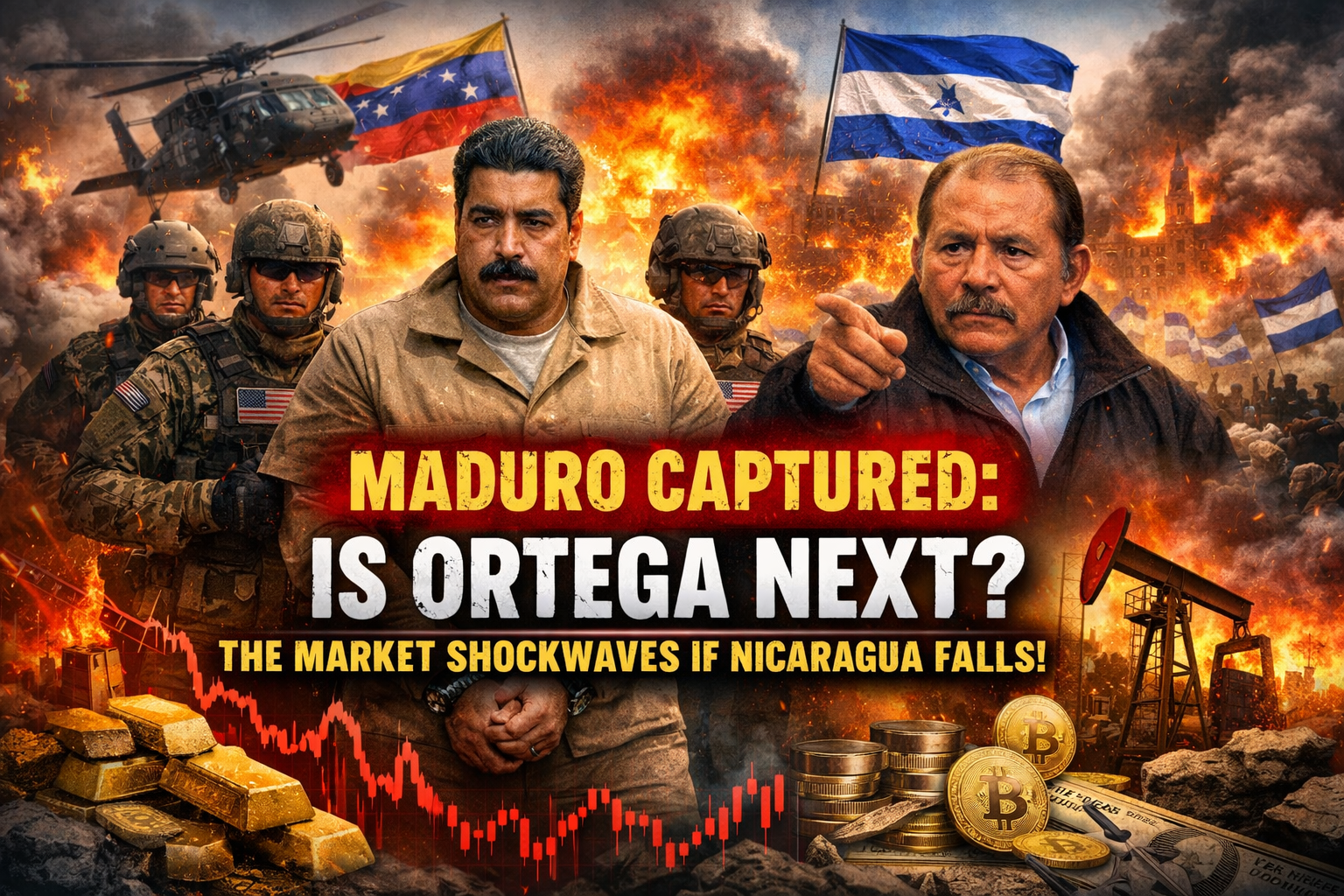
Authoritarian leaders are not all created equal. Some wield such deep institutional, military, or dynastic power that removal seems nearly impossible. Others survive on fragile coalitions, elite loyalty, and economic leverage, making them structurally vulnerable to shocks.
Venezuela’s Nicolás Maduro, long considered entrenched despite economic collapse and political unrest, has now been captured and taken into U.S. custody, marking an unprecedented moment in modern Latin American geopolitics. His sudden removal underscores how even “survivable” authoritarian regimes can be shaken when structural vulnerabilities are exploited.
By contrast, leaders like Xi Jinping, Kim Jong‑un, and Vladimir Putin remain anchored by massive state capacity, family cults, or elite security networks, making them effectively untouchable. Meanwhile, Daniel Ortega in Nicaragua represents a structurally vulnerable regime - one whose disruption could ripple through crypto, commodities, forex, and defense stocks.
THE "UNTOUCHABLE TRIO": XI, KIM, AND PUTIN
Xi Jinping (China)
Xi controls a high-capacity party-state, fusing the Communist Party, military, courts, and surveillance into a single power structure. Rival factions have been purged, term limits abolished, and loyalty continuously enforced. Removal would be internal, surgical, and quiet, not the result of protests, coups, or foreign pressure.
Kim Jong‑un (North Korea)
Kim’s power is dynastic and semi-religious. The bloodline legitimizes the regime, while overlapping security agencies, nuclear deterrence, and population isolation create a near-impenetrable shield. If Kim were to fall, it would most likely be due to health or succession failure, not elite betrayal or popular revolt.
Vladimir Putin (Russia)
Putin relies on a security-elite consensus and control over energy rents. Elite fragmentation could theoretically threaten his rule, but the cohesion of Russia’s security apparatus and strategic leverage make him far more durable than smaller leaders like Maduro or Ortega.
WHY NICARAGUA COULD BE AMERICA'S NEXT TARGET
Unlike China, North Korea, or Russia, Nicaragua is a low-capacity authoritarian state:
- Narrow ruling coalition: Ortega depends on family, party loyalists, and select security leaders.
- Small economy: Limited fiscal buffers, minimal oil leverage, and dependence on remittances and trade.
- No strategic patron: Unlike Belarus or Syria, Nicaragua lacks a great-power umbrella that guarantees survival.
- Succession ambiguity: Power is personalist and family-centered, increasing vulnerability to elite shock.
These structural conditions make the regime more sensitive to elite fracture, economic pressure, and legitimacy crises, factors that analysts cite as key in leadership transitions in smaller authoritarian states.
LESSONS FROM GLOBAL AUTHORITARIANISM
- Xi, Kim, and Putin: Not grabbable through popular unrest or conventional pressure. Survival is anchored in deep institutions, elite control, and strategic leverage.
- Maduro (Venezuela): Despite economic collapse, hyperinflation, and widespread unrest, Maduro was long thought to be entrenched. Yet the U.S. military operation this weekend resulted in his capture and removal, showing that even low-to-mid capacity authoritarian regimes can be suddenly destabilized when structural vulnerabilities are exploited and external leverage is applied.
- Ortega (Nicaragua): Shares characteristics with Maduro’s Venezuela - narrow elite base, economic weakness, and lack of strategic patrons. This means his rule is far more structurally fragile than the untouchables, and any major disruption would likely send shockwaves through global financial markets.
MARKET REALITY: WHAT ASSETS PUMP IF ORTEGA IS GRABBED BY HIS PUSSY
A sudden disruption of Ortega’s power, or even a credible risk thereof, would trigger immediate market reactions, as investors price in instability, sanctions, and capital flight.
1. Crypto Assets
- Bitcoin (BTC): Safe-haven narrative, capital flight hedge
- Stablecoins (USDT, USDC): Surge from wealth preservation and cross-border liquidity demand
- Privacy coins (XMR, ZEC): Speculative spike on sanctions-evasion narratives
2. Commodities
- Gold: Classic geopolitical hedge
- Silver: Tracks gold with volatility
- Oil (WTI / Brent): Mild risk-premium bump
- Coffee: Directly affected - Nicaragua is a key coffee producer, so any disruption could spike prices
3. Forex
- Strengthens: USD, JPY, CHF
- Weakens: Nicaraguan córdoba, nearby EM currencies
4. Stocks
- Defense: Lockheed Martin (LMT), Raytheon (RTX), Northrop Grumman (NOC), General Dynamics (GD)
- Energy & Materials: ExxonMobil (XOM), Chevron (CVX), Freeport‑McMoRan (FCX), gold miners (NEM, AEM, GOLD)
- Does NOT pump: LATAM growth equities, tourism, airlines, EM bonds - usually sell off first
THE BIG PICTURE
- Xi, Kim, and Putin: Nearly impossible to remove through conventional pressure.
- Maduro: Demonstrated how even seemingly resilient low-capacity regimes can be removed when structural vulnerabilities are exploited and external leverage is applied.
- Ortega: Structurally vulnerable, making him a potential geopolitical and market shock point in Central America.
Markets respond not to morality or politics, but to structural shocks and risk repricing. Investors and analysts who understand which authoritarian regimes are brittle, and which are nearly untouchable, can anticipate geopolitical and financial ripple effects before headlines fully settle.