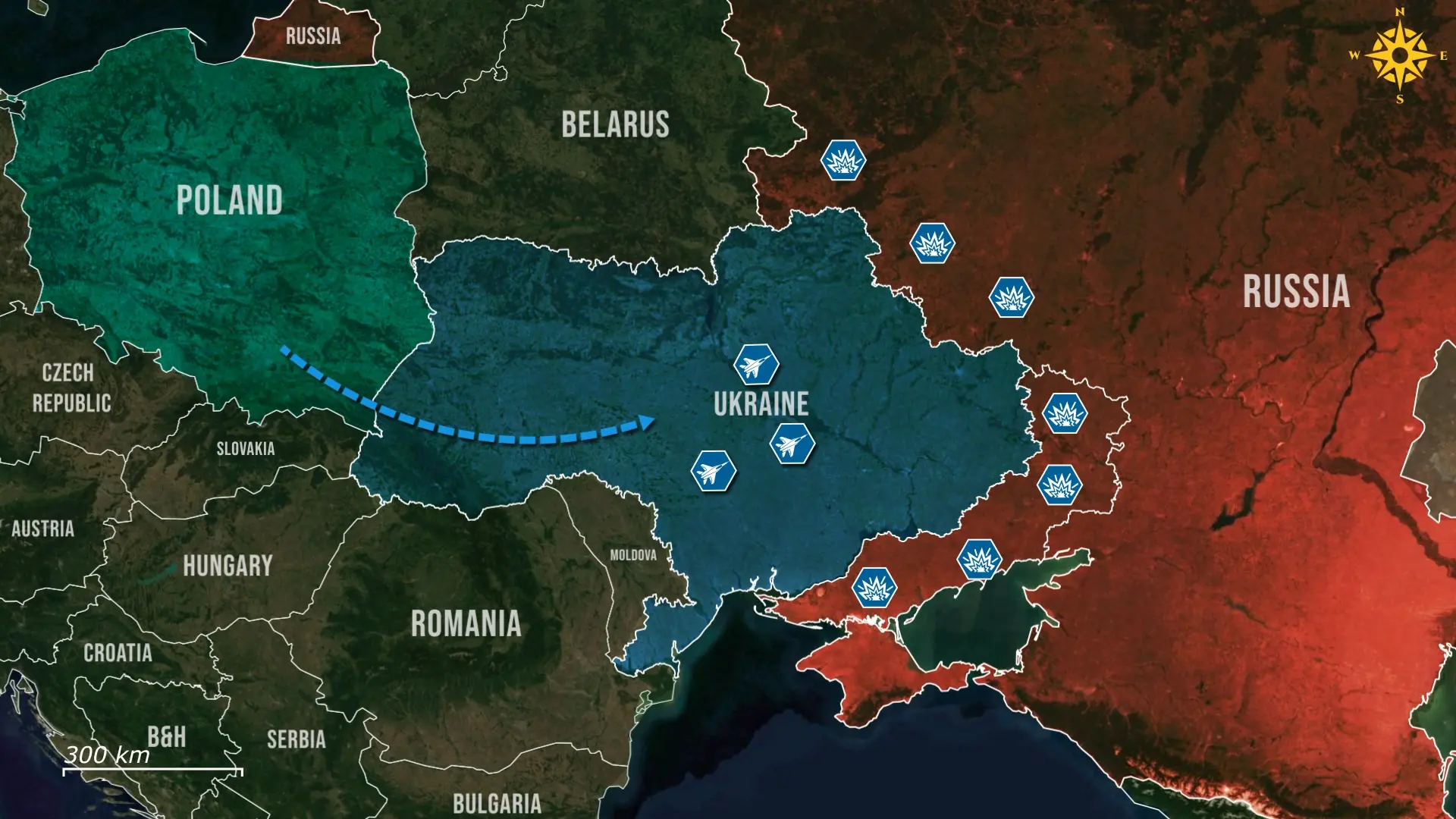
Could a minor incident in Poland spark a full NATO x Russia confrontation? As the Ukraine war drags on, Poland has become NATO’s most sensitive tripwire, its geography and politics putting it closest to accidental escalation.
POLAND'S STRATEGY
Poland’s strategy is to deter Russian spillover without firing first by anchoring NATO visibly and early, protecting Ukraine’s logistics corridors, and immediately raising the cost of any Russian misstep. It achieves this through a combination of NATO lock-in, hosting multinational forces and involving the alliance quickly; escalation compression, rapid attribution and swift diplomatic responses; defensive overkill, visible air defenses, hardened borders, and constant readiness exercises; and narrative dominance, framing incidents as systemic and emphasizing moral clarity.
RUSSIA'S STRATEGY VS POLAND
Russia’s strategy is to avoid direct NATO war while maintaining escalation dominance, testing alliance cohesion, and signaling strength without triggering NATO unity. It does this through controlled ambiguity, operating in gray zones with plausible deniability; peripheral pressure, maneuvering in Kaliningrad and the Baltic and conducting cyber operations; escalation asymmetry, applying non-kinetic pressure, manipulating energy flows, and inducing psychological fatigue; and alliance fracture, exploiting NATO divisions and portraying Poland as reckless.
WHERE MEGASHIT HITS THE STORM-SIZED FAN
High tempo, short distances, defensive misfires, public reactions, and media amplification create risk, neither side wants war, yet both prepare for it.
THE STRATEGIC PARADOX
Poland relies on speed and certainty; Russia on delay and ambiguity. When inevitability meets ambiguity, accidental war becomes possible.
BOTTOM LINE
If escalation spreads beyond Ukraine, Poland is NATO’s likely first target, not by aggression, but by inflexible red lines. Russia bets on ambiguity; Poland bets on inevitability.
Could the world survive a miscalculation where these opposing logics collide?
what happens if russia and nato goes to war ?
ser, china and iran will join russia coz they pissed at what amrika done to venzoyla and amrika loves nato, maybe i dunno lol

ww3?
Yes. a NATO-Russia war would be the clearest path toward World War III but it wont automatically become one. A limited local clash could stay contained if both sides cap objectives and de-escalate quickly but it turns into WW3 if fighting spreads across regions, strategic assets are hit, other major powers join, or nuclear thresholds are crossed. In short, its the doorway to WW3-whether it’s opened depends on control, speed, and mistakes

Just in case ya'll missed the news about the war in the past 3 days, here they are:
1] Western security guarantees (Paris summit) - The US and European allies discussed formal security assurances for Ukraine in the event of a ceasefire.
2] UK-France post-ceasefire troop commitments - The UK and France signaled readiness to deploy troops and establish security hubs in Ukraine after a peace deal.
3] Ukrainian deep-strike drone attacks - Ukraine conducted long-range drone strikes against Russian ammunition depots and energy infrastructure inside Russia.
4] Russian air defense activity - Russia reported intercepting multiple Ukrainian drones across several regions, highlighting expanded defensive coverage.
5] Manpower and attrition focus - Analysts emphasize manpower management, logistics, and endurance as decisive factors shaping the war in 2026.
6] Ceasefire discussions alongside resistance planning - Even amid ceasefire talk, attention is shifting toward potential long-term resistance and instability in occupied territories.
Western security guarantees (Paris summit)
>>Interpretation: “When allies speak louder, they fear weakness.”
>>Deterrence is being reinforced because confidence is not absolute.
UK/France troop pledges after a ceasefire
>>Interpretation: “Occupy the ground before the enemy returns.”
>>This is about shaping the postwar balance, not ending the war.
Ukrainian deep-strike drones inside Russia
>>Interpretation: “Strike what the enemy relies on, not where he is strong.”
>>Ukraine compensates for manpower limits by attacking logistics and morale.
Russian air defenses intercepting drones
>>Interpretation: “The enemy defends everywhere because he fears anywhere.”
>>Strategic overstretch increases long-term vulnerability.
Manpower and attrition focus (2026 outlook)
>>Interpretation: “Victory belongs to the one who manages exhaustion.”
>>This is no longer about bold maneuvers, but who collapses last.
Talk of ceasefire + resistance in occupied territories
>>Interpretation: “A truce without legitimacy is only war in shadow.”
>>Even peace would be unstable and violent by other means.
Verdict:
>>This war is shifting from territory to endurance, from battles to systems.
>>The side that preserves strength while eroding the enemy’s will wins, without needing decisive victory.
@strataghost Thank you for your post! Just sent you 100 $GMBLR tokens. Keep posting!
@cryptohustlr @grungechain @alexjones @bob @southcentralcartel Thanks for all your comments! Just sent you 50 $GMBLR tokens! Keep engaging! Weeeee